


How to choose your Triathlon wheels?
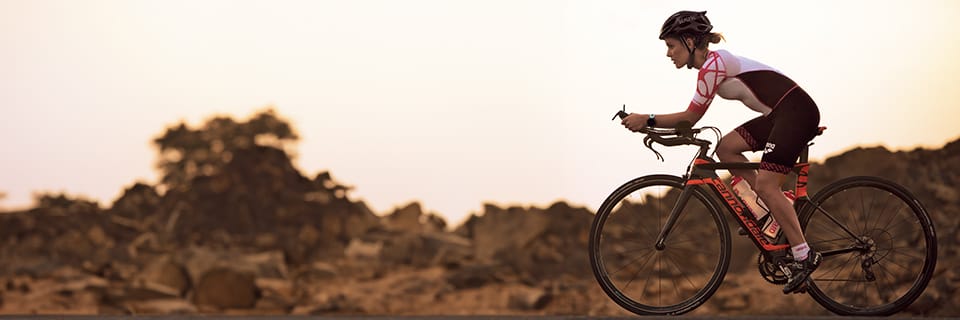
Wheels play a major role in the performance of a triathlon bike. But depending on the type of bike you have — standard or time trial — the nature of the events you take part in, and your level, the most suitable model for your needs can vary greatly.
Here is some guidance to help you make your choice.
Key points
- The types of rims (profiles and materials), spoke configuration and hubs;
- Tubular tyres or tyres (tubetype, tubeless);
- The type of brake: rim or disc.
EVERYTHING YOU NEED TO KNOW ABOUT WHEELS
RIM, HUB AND SPOKES
The rim, the hub and the spokes are the three elements that will determine the specifications of a wheel.
The first question to ask yourself when buying a pair of wheels concerns the rim height (or profile). The height generally varies from 20 to 80 mm. .
The higher the rim, the heavier and more aerodynamic it is: it will be harder to get moving initially but will then display better kinetic energy. You will also have to contend with turbulence in strong crosswinds.
Conversely, the lower the rim, the lighter, more responsive and more comfortable it is, thanks to longer spokes that give the whole wheel greater flexibility. It will get moving much faster than a deep-section wheel, but will then be less efficient once up to speed. While lightness and reactivity are key factors in the mountains, the inertia generated by the rim's weight can prove useful on flat terrain where average speeds are high. On rolling events, aerodynamic deep-section rims are therefore preferred.
There is therefore no perfect wheel, only wheels suited to each discipline.
Wheels are generally classified into three height categories:
Low
(< 30 mm)
Ideal in the mountains or on courses requiring frequent accelerations.
Medium
(30 to 49 mm)
The most versatile, ideal for varied terrain. They are particularly suited to triathletes who do not wish to multiply the number of wheel pairs they own.
Deep
(from 50 mm)
Ideal on flat to slightly rolling terrain and for long distances.
It should be noted that on top-of-the-range pairs, you can find a differentiated height between the front and rear in order to achieve the best possible compromise between comfort, efficiency and handling precision.
In addition to the rim profile, the material also plays an important role. The difference between aluminium and carbon rims is not so much about weight as about responsiveness and stiffness. However, carbon rims are also more fragile, with a greater risk of damage in the event of a crash.
Everything depends on your goals as well as your budget, because while the best-performing aluminium wheel pairs exceed €1,000, this price marks the entry point for carbon wheels. If you have ambitions of winning, carbon rims will naturally become a necessity.
The second component of a wheel is the hub, which integrates the bearing system. The quality of the hub will greatly influence the quality of the wheels. A high-performing rim fitted with poor-quality hubs will not be able to show all its qualities. On the highest-end hubs, ceramic bearings can be found, which help reduce friction. Beyond quality, the bearing system can be either of the "cone/cup" type, requiring more regular maintenance but generally reliable over time, or of the "sealed bearing" type, which is maintenance-free (simply replace the bearing when it is defective).
Finally, last but not least, the spoke configuration, as its role is to ensure a perfect connection between the hub and the rim to transmit power, braking forces and changes of direction. It also tolerates a degree of deformation to provide comfort and robustness. The spoke configuration is defined by the number of spokes on a wheel and the lacing pattern. The more spokes a wheel has, the heavier and stronger it is. Triathlon wheels generally have between 24 and 28 spokes, depending on the model's specifications.
Regarding lacing, the most classic and still the most reliable today consists of spokes crossed by 3 (one spoke always crosses 3 others). You can also find spokes crossed by 2, or radial spokes, i.e. perpendicular to the hub. This last solution is found mainly on front wheels with rim brakes, as it is not strong enough to withstand the stresses of disc braking or the torque of the freewheel.
Regarding the shape of the spokes, flat spokes are stiffer and more aerodynamic. They also handle high tension well. But if you are looking for more comfort, round spokes will be more suitable.
TYRES OR TUBULARS?
Beyond personal preference, the choice between a pair of tyre wheels or tubular wheels has very different implications on a day-to-day basis.
Tubular tyre rims are lighter and allow higher tyre pressures: the result is better efficiency without sacrificing comfort, thanks to a greater capacity for deformation. This makes it easier to take corners at a pronounced attack angle. Tubulars also allow you to ride for a while at low pressure, or even after a puncture, particularly with a repair canister. On the other hand, and this is the main limitation of the tubular, its repair is far more complicated and virtually impossible alone on the roadside (all assistance being forbidden in triathlon). Indeed, a tubular must be fitted at least 24 hours in advance to allow the glue to dry properly.
Tyre rims are above all more practical, as changing a tyre is simple and quick. Moreover, a spare inner tube is much easier to carry than a new tubular. In terms of handling, tyres are often more at ease on wet roads and in cold weather, although this depends on the type of compound. You can fit your tyres at any time, at the last moment if you wish, allowing you to perfectly adapt to weather and race conditions. Finally, the price of a tyre is generally lower than that of a tubular.
It should be noted that more and more rims are Tubeless compatible, meaning they allow fitting without an inner tube. In this case, you get the performance and comfort qualities of tubular tyres without the drawbacks, as the risk of puncture is minimal, and in the event that it does happen and the sealant liquid and/or plugs do not solve the problem, you can always repair it by fitting an inner tube. This solution is therefore increasingly popular among triathletes.
RIM BRAKES OR DISC BRAKES?
As in other disciplines, disc braking is becoming increasingly common in triathlon. New ranges of bikes are now predominantly equipped with disc brakes. The range of wheels is therefore now just as wide for rim brakes as for disc brakes.
Offering both great power and optimal braking modulation, disc brakes maintain excellent braking performance in all conditions and on any type of road, reduce wear and heat build-up on the rim/pad combination, and eliminate problems with cables that oxidise or seize up.
Disc brakes also offer another advantage for triathletes who have one pair of aluminium wheels and one pair of carbon wheels for competition, since you no longer need to change the pads systematically when switching from one to the other, as is the case with rim brake wheels.
In any case, if you already own your bike, you will have no choice and will need to purchase wheels suited to your braking system.
WHICH WHEELS FOR MY RIDING?
In triathlon, wheel choice is crucial to optimising the overall setup and making the most of the frame's characteristics. This choice will be made primarily based on the courses ridden and the weather conditions.
Most triathletes have at least two pairs of wheels, including a basic low-profile rim pair for training and one or more pairs for competition.
Low-profile rim:
A low, lightweight rim is the best choice, guaranteeing punchy climbs and lightning-fast accelerations for mountain use. An entry-level model will also be perfect for training on poor-quality roads and during the winter months when equipment is put to the test.
Higher and more aerodynamic rim:
A higher and more aerodynamic rim is preferable on flat or rolling terrain for its kinetic energy and aerodynamic performance. The essential complement to a Triathlon / TT-oriented bike.
Disc wheel:
The most ambitious riders may use a disc wheel if weather conditions allow (no wind). These wheels are, however, demanding to handle, both physically and technically, and therefore require good mastery. Reserved for experienced and high-level triathletes.
Découvrez tous nos conseils & Tutoriels


